

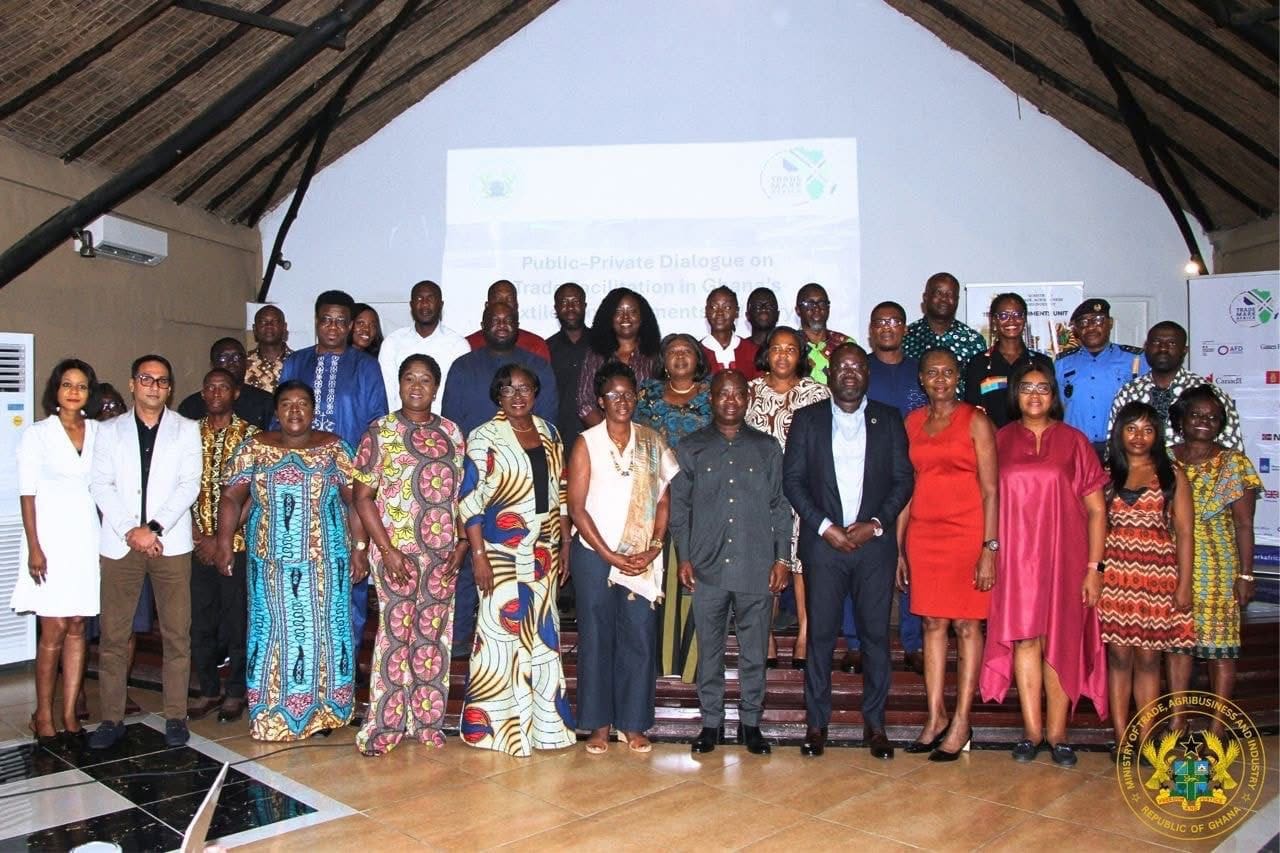
The Ministry of Trade, Agribusiness, and Industry has partnered with TradeMark Africa (TMA) to overhaul trade facilitation and resolve persistent operational bottlenecks within Ghana’s textile and garment sector.
Speaking at a high-level public-private dialogue in Sogakope on February 19, 2026, Deputy Minister Sampson Ahi described the industry as a strategic pillar for the nation’s industrialization and export diversification agenda.
He emphasized that while the sector holds immense potential for job creation—particularly for women and youth—its growth is currently hampered by high costs and prolonged turnaround times driven by inefficient customs procedures and logistics hurdles.
To address these challenges, the Ministry is pushing for the immediate enforcement of the Authorized Economic Operator (AEO) Scheme, which promises faster clearance and reduced inspections for compliant businesses.
Mr. Ahi also noted the necessity of aligning digital trade systems, such as the Integrated Customs Management System (ICUMS), with the specific operational needs of garment manufacturers. The government aims to create a more predictable environment that encourages investment and strengthens Ghana’s position within regional and global value chains.
TradeMark Africa’s Director for West Africa and AfCFTA, Ms. Harriet Gayi, highlighted the urgency of these reforms, pointing to specific issues such as port hour misalignments, documentation delays, and system downtimes that undermine investor confidence.
She remarked that the sector demonstrated its untapped industrial capacity during the COVID-19 pandemic by producing over 14 million facemasks, proving its resilience. According to Ms. Gayi, private sector players are prepared to scale up to a 24-hour, three-shift production model once the government secures an enabling environment.
The two-day engagement concluded with a unified commitment from government agencies, development partners, and manufacturers to implement evidence-based reforms. By streamlining trade systems and collaborating with institutions like the Ghana Standards Authority to enhance product quality, the partnership seeks to reposition Ghana as a reliable and competitive garment manufacturing hub in the West African sub-region.
Both the Ministry and TMA underscored that these efficiency gains will translate directly into sustainable job creation and broader economic inclusion for the nation’s workforce.
Ruth Abla ADJORLOLO