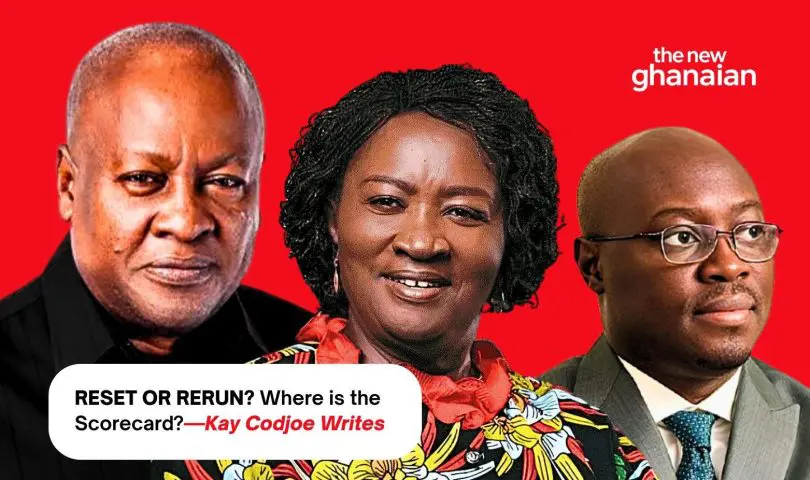

Ghanaians did not vote casually in the last election. They voted with memory, frustration, and hope. After eight turbulent years widely criticised as one of the most difficult governing periods of the Fourth Republic, the electorate delivered a decisive mandate to the Mahama led NDC administration. The defeat handed to the NPP was not just political. It was psychological. It reflected economic fatigue, institutional distrust, and a collective yearning for stability.
The new government arrived with a powerful slogan: RESET. Alongside it came Operation Recover All Loot, widely branded as ORAL, a signal that accountability would sit at the centre of governance. That message resonated strongly. Citizens wanted recovery, but they also wanted closure.
To their credit, the early economic signals have been encouraging. Inflation, which once galloped into painful territory, has begun trending downward. The cedi, long battered by volatility, has shown relative stability. Foreign exchange reserves have strengthened modestly. Fiscal consolidation measures appear to be tightening public spending discipline. Debt restructuring negotiations restored some external confidence, reducing immediate default anxiety. Investor sentiment, while cautious, is no longer openly pessimistic.
These indicators matter because economics is not abstract. It is food prices, transport fares, school fees, hospital bills, business survival.
Some policy interventions have also stood out.
The renewed fiscal discipline programme has attempted to curb wasteful public expenditure while improving revenue collection. This has helped moderate deficits and calm markets.
The aggressive anti corruption posture, symbolised by ORAL, has signalled that impunity may no longer be cost free. Even if prosecutions take time, the psychological effect alone reshapes behaviour.
Agricultural support interventions, particularly fertiliser access reforms and targeted input subsidies, have aimed to stabilise food production and ease inflationary pressure on staples.
Energy sector payment restructuring has also reduced some of the financial leakages that previously threatened power stability.
Financial sector engagement with international partners has improved credit outlook conversations, even if full recovery remains gradual.
These are not minor steps. They are important.
Yet governance is not judged only by direction. It is judged by transparency, consistency, and measurable progress.
Major unresolved challenges remain stubbornly visible.
Illegal mining continues to degrade forests and pollute water bodies despite repeated commitments. Citizens hear strong rhetoric, but visible enforcement still appears uneven.
COCOBOD faces structural financing stress, farmer payment concerns, productivity stagnation, and governance questions that have persisted across administrations.
Judicial reform remains an unfinished conversation, particularly regarding public confidence, case backlog, perceived political influence, and access to justice.
Public procurement transparency still raises eyebrows.
State owned enterprise efficiency continues to fluctuate.
These are not inherited problems alone. They are governance tests unfolding in real time.
Which brings us to a simple but uncomfortable question.
Where is the government’s public progress tracker?
Where is the regularly updated dashboard that tells citizens exactly what has been promised, what has been achieved, what is delayed, and why?
In a digital era, transparency should not depend on press conferences, partisan commentary, or scattered ministry briefings. A nation that demanded a RESET deserves measurable evidence of that reset.
Not slogans. Not selective announcements. Data.
Imagine a national accountability portal showing:
Key economic indicators updated monthly.
Anti corruption investigations and recovery status.
Environmental enforcement statistics on illegal mining.
Agricultural productivity metrics.
Judicial reform milestones.
State enterprise performance scorecards.
That would transform political trust.
Because trust today is cautious. Optimism exists, but it is conditional. Citizens appreciate the early stabilisation signals, yet they remain watchful. Ghanaians have lived through promises before.
The Mahama administration has a genuine opportunity. Economic stabilisation provides breathing space. ORAL provides a moral narrative. The electoral mandate provides legitimacy.
But legitimacy matures through transparency, not repetition of campaign language.
So here is the question many citizens are quietly asking:
Are we truly witnessing a RESET, or simply another rerun with better messaging?
The answer will not come from speeches.
It will come from measurable progress that every Ghanaian can see.
Kay Codjoe