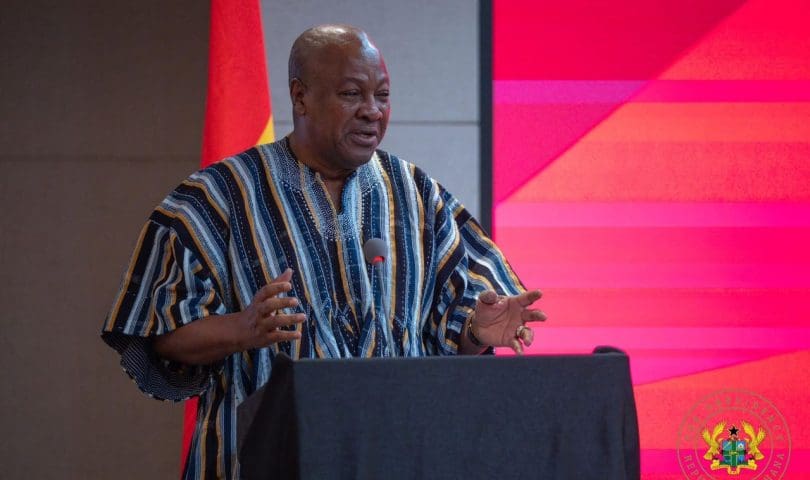

President John Mahama has introduced the Accra Reset Initiative (ARI), a bold global development framework aimed at redefining Africa’s growth by dismantling the continent’s long-standing reliance on external actors.
Formally launched on the sidelines of the UN General Assembly, the initiative addresses what President Mahama describes as a “tripled dependency” involving a reliance on foreign powers for security, international donors for social services, and external firms for mineral value chains.
The ARI is built upon the core principles of sovereignty, workability, and shared value, seeking to transition the continent from a culture of foreign aid to a model of self-sustaining investment through the creation of “prosperity spheres.”
Central to the initiative’s immediate agenda is the pursuit of health sovereignty, building on the foundations of the Africa Health Sovereignty Summit held in Accra in August 2025. The plan prioritizes the expansion of local manufacturing for vaccines and medical supplies, the development of a highly skilled healthcare workforce, and a strategic reduction in the market share of imported medical items.
By focusing on health as a critical starting point, the ARI aims to address the stagnation of global health goals while asserting Africa’s capability to manage its own essential services.
This strategic move is widely viewed as Ghana’s bid to reclaim its position at the forefront of African leadership, echoing the Pan-Africanist legacy of the nation’s founding president, Kwame Nkrumah.
By aligning with the African Union’s Agenda 2063, President Mahama intends for the ARI to serve as a modern vehicle for “African solutions to African problems.”
The framework represents a significant diplomatic effort to link Ghana’s national progress with the broader liberation and economic independence of the entire continent, signaling a new era of proactive Ghanaian leadership in global and regional affairs.
Ruth Abla ADJORLOLO