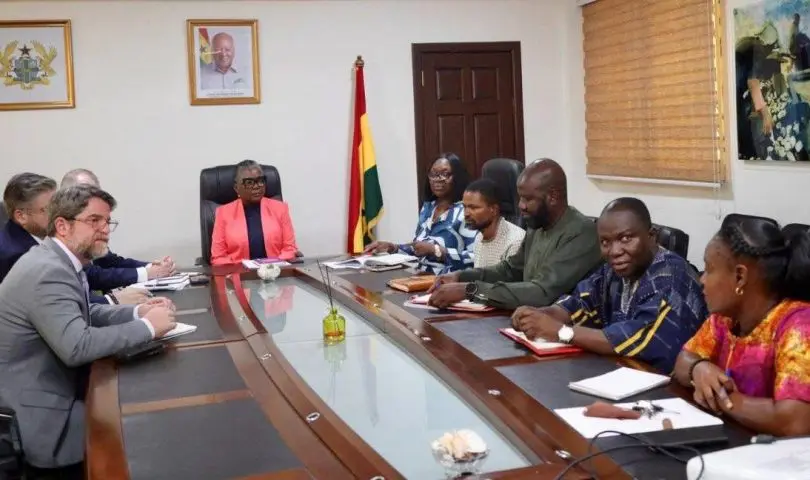

A high-level delegation from the United States Embassy in Accra has held a strategic consultative meeting with the Minister for Fisheries and Aquaculture, Emelia Arthur, aimed at deepening cooperation within Ghana’s maritime and aquaculture sectors.
The visit, led by Deputy Chief of Mission Rolf Olson, served as a formal diplomatic introduction following his recent assumption of duty, while simultaneously providing a platform to address urgent industrial challenges.
Central to the discussions was the shared global threat of Illegal, Unreported, and Unregulated (IUU) fishing. Mr. Olson characterized IUU fishing as a critical menace that undermines marine ecosystems, threatens the livelihoods of local coastal communities, and compromises national food security.
He reaffirmed the U.S. Government’s commitment to supporting Ghanaian-led initiatives that strengthen maritime governance, enhance sustainability standards, and pave the way for increased private-sector investment across the fisheries value chain.
Mr. Olson further noted that the U.S. sees significant potential for growth through the introduction of innovative technologies and technical expertise, which could attract responsible international investment to support Ghana’s expanding blue economy.
In her response, Emelia Arthur emphasized that the development of the aquaculture sector remains a cornerstone of the government’s economic agenda. She highlighted its potential to drive industrial growth and provide sustainable employment opportunities, particularly for the youth and women.
However, the Minister was candid about the obstacles currently facing the sector. She identified specific capacity gaps, most notably the need for advanced vessel monitoring systems (VMS) to bolster sea surveillance and more robust fish health management frameworks to ensure a resilient, modern industry.
The Minister stressed that strategic alliances with international partners like the United States are indispensable for bridging these technical and infrastructural divides. By collaborating on research, technology transfer, and rigorous enforcement, both nations aim to ensure that Ghana’s fisheries move toward a future of long-term sustainability and industrial prosperity.
Ruth Abla ADJORLOLO