
By Kay Codjoe
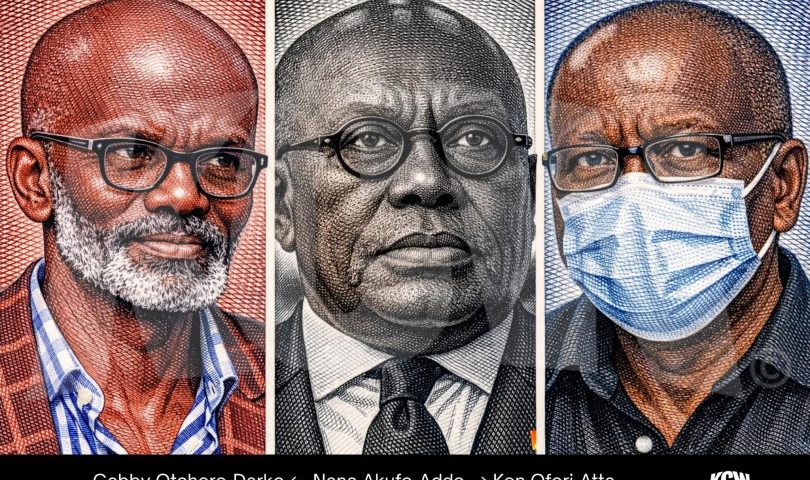
Every political era has its quiet architecture of power. In Ghana’s last eight years, that architecture could be traced to a triangle: Nana Addo Dankwa Akufo-Addo, the president; Ken Ofori-Atta, the finance minister; and Gabby Asare Otchere-Darko, the strategist, cousin, and behind-the-scenes nerve center of the New Patriotic Party.
They were not equals in office, but they were inseparable in influence.
Akufo-Addo provided the authority. Ofori-Atta controlled the money. Otchere-Darko shaped the narrative, the strategy, and often the political mood music that tried to explain away what citizens were living through. Between them sat the real engine of the state, a small, tightly held circle that made decisions with enormous consequences for over 30 million people.
For eight years, Ghanaians were asked to trust this arrangement. When the economy faltered, we were told it was global. When the debt exploded, we were told it was necessary. When the cedi collapsed and living costs soared, we were told to be patient. And when Ken Ofori-Atta became the most controversial finance minister of the Fourth Republic, he was kept in office, defended, and shielded, long after public confidence had drained away.
This was not an accident. It was a choice. A political choice rooted in loyalty, family ties, and the belief that control of the system was more important than the warnings coming from the street, the market, and even Parliament.
Today, the story has turned.
Ken Ofori-Atta is no longer the immovable fixture at the Ministry of Finance. He is in the United States, in the custody of U.S. Immigration and Customs Enforcement, detention number 720, in court, facing possible deportation and legal processes that may yet force a reckoning he avoided at home. There is a cruel irony in it. He seemed to think he was running from a gun, only to be hit by a bus.
And now a question hangs in the air, heavy and unavoidable: will his deportation or extradition implicate more people, even the former president, Nana Akufo-Addo himself?
Suddenly, the triangle looks less like a fortress and more like a closed room with no windows.
History will judge that era by its outcomes: a battered economy, a humiliated currency, and a public that learned, too late, the cost of allowing power to become too concentrated and too personal.
Nana Akufo-Addo will be remembered as the president who allowed this system to stand. Gabby Otchere-Darko as the strategist who sustained it. And Ken Ofori-Atta as the man who ran the numbers until the numbers ran the country aground. The others?
Time will tell. History always does.
And yet, as we watch and, in some quarters, even celebrate Ken Ofori-Atta’s detention and trial in a justice system in the United States that prides itself on being no respecter of persons, a harder question waits at home: can we honestly say the same about our own justice system? A system plagued by questionable questions, selective courage, and a long history of powerful men who never seem to meet the full weight of the law.
Kay Codjoe