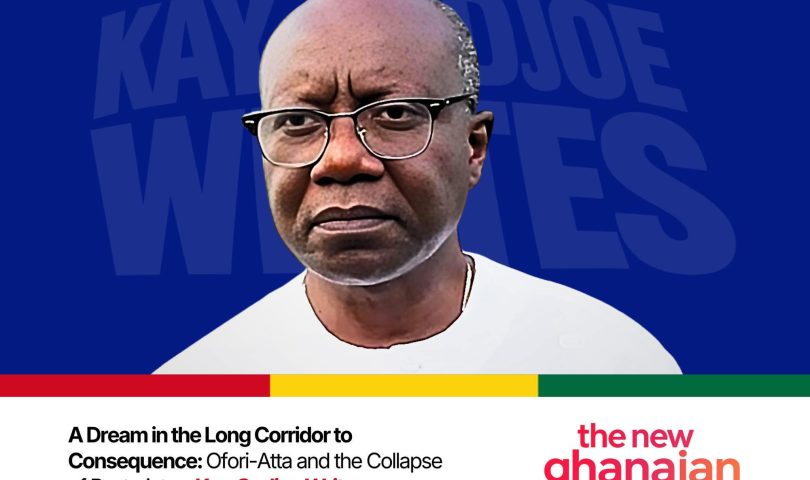

By Kay Codjoe
Not the kind that brings prophecies or lottery numbers. This one came with files, brown folders, red tags, and the smell of old paper and new fear.
In the dream, Ghana was not a country. She was a long corridor. At the end of it stood a door with a brass nameplate.
KEN OFORI ATTA.
The door was not locked. It never is.
Inside, I did not find a monster. I found a tired man surrounded by lawyers, spreadsheets, medical reports, and a nation’s worth of explanations. On the walls hung charts that tried to look like plans and contracts that tried to look like ideas. On the floor lay debts that refused to look like numbers.
He was not running. He was explaining. He had been explaining for years.
When the cedi fell, he explained. When debt rose, he explained. When taxes multiplied, he explained. When reserves vanished, he explained. When the cathedral swallowed money and refused to become a building, he explained.
Every failure came with an excuse. Every disaster arrived with a footnote.
In the dream, Ghana sat in the corner like a patient who had heard too many diagnoses and too few cures.
Then the room changed.
The spreadsheets became hospital bills. The contracts became court papers. The briefings became summonses. The explanations became silence.
Somewhere far away, in a cold American facility, the Republic was learning a new sentence. Detained. Pending review.
Not convicted. Not yet. Just paused.
The mighty accountant of a wounded nation had become a detainee in another country’s system.
Then the ghosts came. They did not come angry. They came quiet.
Nkrumah looked at the debts and did not ask who signed them. He asked what they were for.
Busia asked where the discipline went.
Acheampong shook his head and muttered that even his mistakes now looked modest.
Rawlings said nothing. He only stared like a man watching a child burn a house and call it progress.
Atta Mills walked past Korle Bu, past places where people still die of things that should not kill anyone in a serious country.
They were not judging a man. They were reading an era. They were reading how a republic learned to confuse cleverness with wisdom and confidence with competence.
In the dream, Ofori Atta was still explaining.
He explained that the world had changed. That the shocks were external. That the markets were nervous. That the models were sound. That the pain was necessary. That history would be kind.
But history was not in the room. Only consequences were.
Consequences do not listen to explanations. They listen to hospital wards, classrooms without roofs, shops without customers, and young people whose only export is themselves.
Then I understood something cruel.
This story is not really about Ken Ofori Atta.
He is only the most famous signature on a national habit.
The habit of mortgaging tomorrow to survive today.
The habit of confusing access with insight.
The habit of believing that good English can defeat bad arithmetic.
He did not invent this system.
He simply drove it faster and told us it was a highway.
And now the car is in a ditch.
When I woke up, Ghana was still here. Still noisy. Still proud. Still wounded. Still arguing.
But something had shifted.
For the first time in a long time, the Republic had watched one of its untouchables become touchable.
Not punished. Not yet. But interruptible.
And that is how accountability begins.
Ghana is not poor. She is mismanaged. She is not unlucky. She is undisciplined.
Until we learn that public office is not a private experiment, we will keep producing brilliant men who can explain anything except why nothing works.
Kay Codjoe