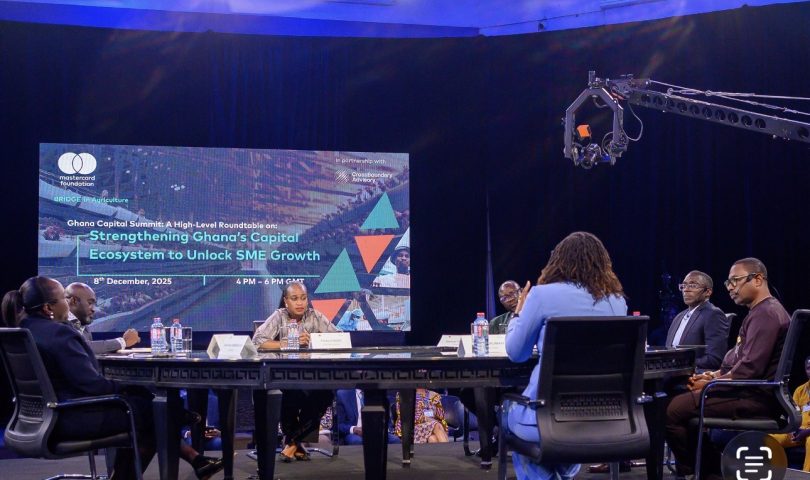

Ghana’s Leaders Chart Path to Close $5 Billion SME Financing Gap
Accra, Ghana (December 8, 2025) – Ghana’s financial and policy leaders have agreed that closing the country’s estimated $5 billion SME financing gap requires stronger coordination between traditional banks, private credit investors, blended finance providers, and SMEs themselves.
This was the central takeaway from a high-level roundtable convened by CrossBoundary Advisory, in partnership with the Mastercard Foundation through BRIDGE-in Agriculture, which brought together over 50 leaders from finance, enterprise, and government to examine how Ghana can mobilize domestic capital at scale.
SMEs: The Backbone of Ghana’s Economy
Small and medium enterprises (SMEs) make up 92% of all business enterprises in Ghana, contribute 60–70% of GDP, and account for 70–80% of national employment. Yet these vital businesses face a combined $5 billion financing gap that severely constrains their growth and job creation potential.
While traditional banks provide some support, structural gaps persist in the financial ecosystem — ranging from high interest rates and collateral requirements to limited understanding of sector-specific business models. The roundtable assessed these challenges in detail, examining how Ghana can position key players to attract more complex capital structures and adapt financing models to local realities.
Key Voices at the Roundtable
Moderated by Fanta Conde, Partner at CrossBoundary Advisory, the session featured:
- Pearl Nkrumah, Managing Director, Access Bank
- Charlotte Amanquah, Regional Head of Commercial Banking for Anglophone West Africa, Ecobank
- Dr. Ishmael Dodoo, Head of Innovative Finance, Partnership & Markets, 24-Hour Economy Secretariat
- Kwadwo Adjei-Barwuah, Head of Investments, Growth Investment Partners
- Ashwin Ravichandran, Portfolio Advisor, MEST Africa
- Alfred Otoo, Project Director, Precise AgroProcessing
- Samuel Yeboah, Chief Operating Officer, GIRSAL
Enterprise Perspectives
Entrepreneurs shared firsthand challenges in accessing and deploying capital. Alfred Otoo, Project Director at Precise AgroProcessing, described his experience in the cassava value chain, where scaling from research to commercial planting requires years of investment and substantial working capital.
“SMEs like ours struggle to access working capital because lenders cite lack of revenue as a concern,” Otoo said. “But this is impractical in an industry that requires patience. We need models that work with our realities—receivables-backed lending that unlocks cash to operate.”
Pearl Nkrumah emphasized ecosystem-wide collaboration, urging SMEs to engage with capacity-building programs tailored by banks.
Building Financial Infrastructure
A critical priority discussed was establishing a central trusted credit scoring system to help banks better profile and assess SMEs.
“We don’t have a lending problem in this country—the problem is that data is siloed,” Nkrumah said. “Banks and telcos should come together to establish a central scoring system that we can all trust to reduce the risk that we face.”
Unlocking Pension Funds and Patient Capital
Kwadwo Adjei-Barwuah highlighted the untapped potential of pension funds to meet SMEs’ long-term financing needs.
“The pension funds should be the readiest, given the amount of capital they have access to and their investment horizons,” he said. “Some SMEs need one- or two-year facilities, but many need five, six, seven years, and that matches with the investment horizons of these pension funds.”
Dr. Ishmael Dodoo reinforced this point, stressing that pension schemes must first show confidence in Ghana’s economy: “You can’t bring in capital from innovative external sources if we don’t show ourselves investing first.”
Government Strategy
Dodoo revealed that the government is working with the Bank of Ghana, GIRSAL, and commercial banks to test innovative financing policies that unlock capital for SMEs at scale.
“We are creating an SME facility with affordable, patient capital for SMEs in partnership with banks,” he said. “As government, we should bring in that capital through our credibility, then on-lend through the banks in ways that meet SME realities.”
He noted that the government has already mobilized $500 million toward this effort.
The Way Forward
The roundtable outlined a roadmap to close Ghana’s SME financing gap, centered on:
- Establishing a central, trusted credit-scoring system to harmonize data across institutions.
- Developing financing models that assess cashflows at different business stages.
- Enabling pension funds to deploy more capital into SME financing.
- Implementing flexible provisioning requirements for banks.
- Collaborating with the Bank of Ghana on base rate management to make lending more affordable.
- Leveraging technology to streamline agricultural value chains and ensure clear information flow to farmers and last-mile actors.
Speakers emphasized blended finance, collaborative platforms, and ongoing technical assistance as essential to catalyze affordable lending and protect SMEs from foreign exchange risks.
Consensus
The roundtable concluded that thoughtful design, strong partnerships, and coordinated action across the ecosystem can fundamentally transform SME access to capital in Ghana.