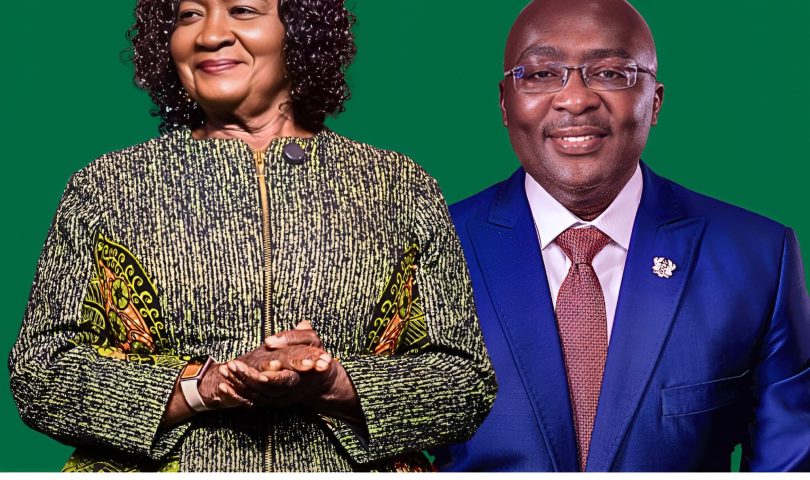

By Kay Codjoe
Ghana has a habit of swinging between extremes. We either praise leaders too quickly or condemn them too fast. We rarely stop in the middle to look at the facts, to test the evidence, to ask what is working and what is not. So when people speak about the work of the current vice president, Prof. Naana Jane Opoku-Agyemang, in her first year, it is important not to turn it into a celebration or an attack. The country deserves a sober look at what has been done, what remains uncertain, and what still needs to be explained.
There is no denying that the numbers have shifted in the past year. The cedi has held its ground more firmly than we have seen in a long time. Inflation, although still high for comfort, has continued to fall from its crisis peak. Some of the leakages in spending have been tightened. Investors who once stood back have begun to test the waters again. These things did not happen by accident. They came from meetings held, instructions issued, and decisions made by people with actual responsibility.
Still, these improvements do not mean the country is healed. Prices remain stubborn. Jobs are not returning fast enough. Public trust is fragile. Many families feel the difference only on paper, not in their pockets. So the truth is somewhere in between. Progress has been made. The pain has not disappeared.
The digital reforms follow a similar pattern. Systems that once misfired are being corrected. Ghost names are being phased out. Data architecture is being cleaned. Agencies that were once politicised seem to be getting room to breathe. It is real work. But it is also work that Ghanaians do not fully understand because almost none of it has been publicly documented. And that creates a gap between effort and perception.
In health and social policy, the narrative is mixed. Teacher and nurse postings have been streamlined, but the backlog was deep. Hospital projects have resumed, but ordinary citizens still struggle with basic access. The push for more cath labs is a necessary national step, but the tragedy that inspired it still weighs heavily. Again, progress exists beside unfinished work.
Even in governance, the absence of scandal is welcome, but silence alone does not prove purity. Institutions appear more stable, but the public still needs to see outcomes. Transparency has improved, but not enough to rebuild full confidence.
And this brings us to the question that cannot be ignored. If these achievements are real, if the work is grounded, if the reforms are substantive, then why has the vice president not issued a consolidated update so Ghanaians can see, in one place, what has actually been achieved? Why leave the field open to speculation, doubt and political interpretation when a structured national report could give Ghanaians clarity?
It is not enough to work quietly. In a democracy, accountability is not optional. Citizens need to see what has been done with the authority they entrusted. They need to judge the facts for themselves, not through political filters. Almost a year in office is long enough for a basic record of progress. It is also long enough for fair criticism where gaps remain.
The contrast with her predecessor, Dr. Mahamudu Bawumia, now a flag-bearer hopeful of the NPP, is clear to anyone willing to look, but comparison is only useful when it pushes all leaders toward higher standards. The country does not need noise or overhype. It needs honesty. It needs consistency. It needs a leadership culture where achievements are not whispered and failures are not hidden.
The vice president, Prof. Naana Jane Opoku-Agyemang, has done meaningful work, but she must show the country what exactly has been done. Ghana deserves that level of transparency, not flattery. A quiet leader can still be an accountable one.
At the end of it all, the story here is not about praise or blame. It is about truth. And truth is strongest when it is written down for the nation to see.