
By Fuvi Kloku And Dr. Mamie Kutame
The enduring spirit of humanity often reveals its greatest strength not in fierce competition, but in tender compassion. This profound truth rings clearest when one steps back from the precipice of loss and looks upon the path of recovery, guided not by personal might, but by communal grace.
The Echo of Natural Selection
For generations, the framework of Charles Darwin’s theory of natural selection has dominated our understanding of survival. The phrase “survival of the fittest,” a succinct description of the mechanism by which organisms best adapted to their environment pass on their traits, has become shorthand for a ruthless, self-reliant struggle. In this view, the “fittest” are those with inherent advantages: sharper claws, quicker speed, or, in a societal context, greater personal resilience or better resources.
Yet, when facing a life-threatening illness, this framework feels incomplete, even cold. Survival in the face of a terrifying diagnosis is often attributed to the “fight,” the individual’s will, a metaphor of lone combat against a biological enemy or illness. Having survived what so many others, equally deserving of life, did not, a profound, perplexing guilt arises. Why me? Why was I “fit” to live when others have passed on?
The answer, lies beyond the individual’s biological wiring.
From “Fittest” to “Nurtured”: A Community Calculus
A personal survival, and the flourishing that follows, compels one to propose a necessary amendment to Darwin’s great law, especially when applied to human community healing and recovery. We may call it the “survival of the nurtured,” a concept developed by Louis Cozolino.
The true adaptive advantage, the “fitness” that ensures our thriving, is not a solitary trait but a deeply intertwined quality: the capacity to give and receive nurturing care.
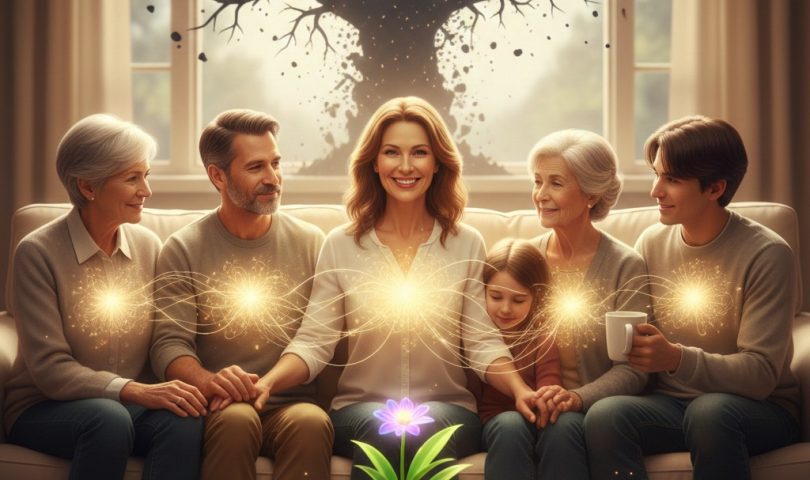
The journey through diagnosis and recovery was not a solitary endeavor. It was a pilgrimage supported by a veritable army of love. The energy, the very will to take the next breath and face the next treatment, came, in large part, from the community: husbands, friends, and a network of support that wrapped around the patient like a protective cocoon. Every phone call, every note, every surge of positive energy channeled toward the patient, these were not merely kind gestures; they were essential, life-sustaining resources.
The nurturing environment created by a community becomes the fertile ground in which strength could finally take root. It was the nurturing that enabled those struggling with diseases survive and, more importantly, to genuinely thrive. We are social beings; our biology is designed to respond to connection. Stress hormones dissipate in the presence of love; the immune system is bolstered by hope and gratitude. In essence, the environment that truly determines “fitness” is the one we build for each other, an environment rich in compassion.
The Art of Intimacy and the Path to Healing
The insight gleaned from this experience offers a compassionate mandate for how we interact with those who are struggling.
We must embrace the power of attuned communication. When a loved one is in crisis, we often default to demanding updates or offering unsolicited advice. The more powerful, more healing inquiry is simpler and more respectful of their besieged energy: “How are you doing today?”
This question honors their daily reality without burdening them with the obligation to provide a sweeping, comprehensive narrative of their pain. It is an act of deep intimacy and compassion, signifying a commitment to meet them precisely where they are, in that specific moment. To be truly “in tune” with those we are intimate with, to sense their needs without them having to articulate them perfectly, is the highest form of nurturing.
The Glow of Gratitude
During this Thanksgiving, we should all be deeply grateful. Grateful for being alive, for the unearned blessing of presence with our loved ones, and for the life-saving intervention of medical science and spiritual grace. But our greatest gratitude is reserved for the boundless capacity of human connection.
The concept of the Survival of the Nurtured dictates that our lives are woven into a tapestry of mutual support. We survive by being cared for, and we heal by extending that same care to others. This shared vulnerability is not a weakness; it is the ultimate measure of our strength.
Our thanks echo deeply: to God, to family, friends, and community. We should be thankful for the prayers, the support, and for proving that when we nurture one another, we not only survive but we learn how to glow.
Happy Thanksgiving