


ACCRA, Ghana – The Institute of Economic and Research Policy Promotion (IERPP) states it has been vindicated by the International Monetary Fund’s (IMF) recent caution to the Ghanaian government regarding its management of the cedi’s stability.
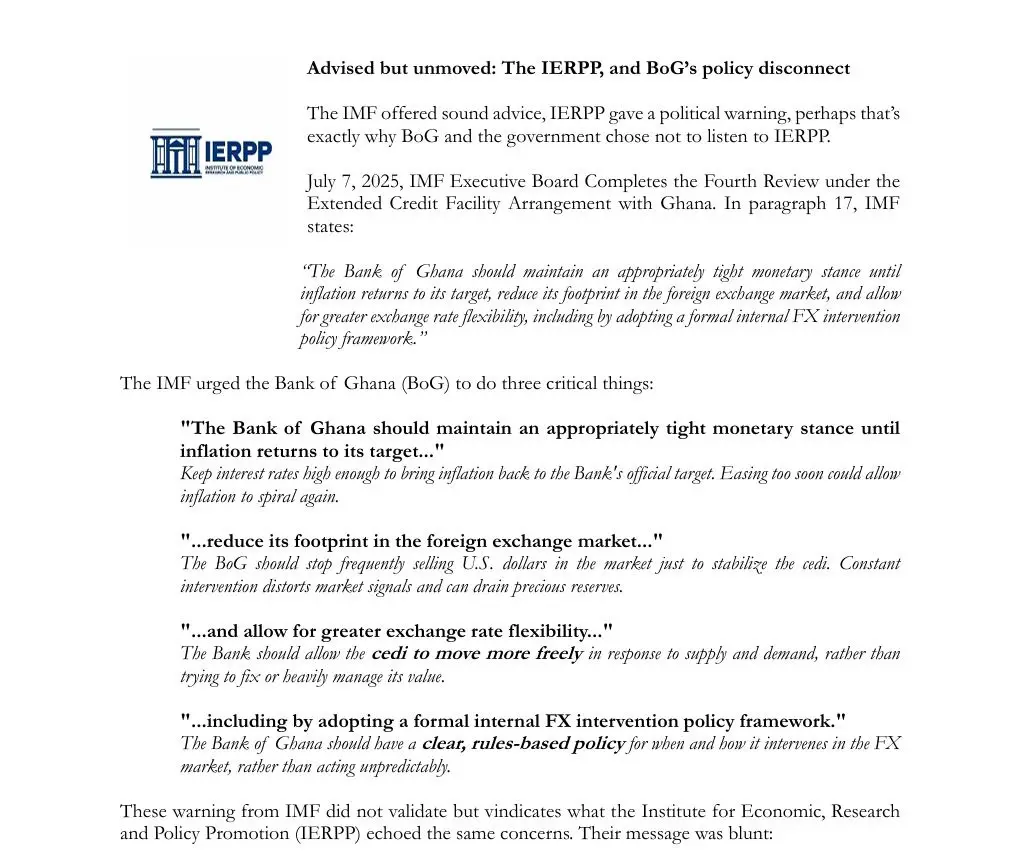
The IMF’s Executive Board, in its fourth review under the Extended Credit Facility Arrangement with Ghana, raised concerns about the government’s practice of injecting foreign exchange to support the cedi rather than allowing market forces to determine its value.
The IMF explicitly advised, “The Bank of Ghana should maintain an appropriately tight monetary stance until inflation returns to its target, reduce its footprint in the foreign exchange market, and allow for greater exchange rate flexibility, including by adopting a formal internal FX intervention policy framework.”
In a statement signed by its Executive Director, Professor Isaac Boadi, who also serves as the Dean of the Faculty of Accounting and Finance at UPSA, the IERPP noted that it had previously issued similar warnings to the government that went unheeded.
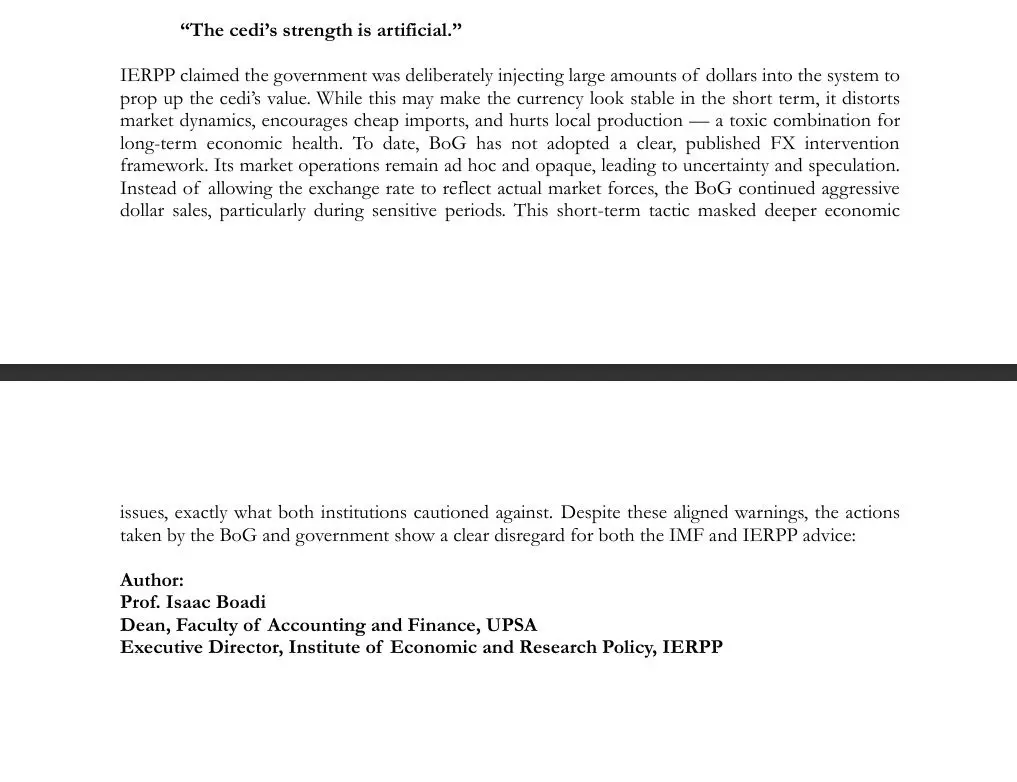
The IERPP asserts that the IMF’s concerns validate its earlier assertions that “the government was deliberately injecting large amounts of dollars into the system to prop up the cedi’s value.”
The IERPP highlighted that while such interventions might create short-term currency stability, they “distort market dynamics, encourage cheap imports, and hurt local production — a toxic combination for long-term economic health.” The institution further criticized the Bank of Ghana (BoG) for its lack of a clear, published foreign exchange intervention framework, stating that its market operations remain “ad hoc and opaque,” leading to uncertainty and speculation.
According to the IERPP, the BoG continued aggressive dollar sales, particularly during sensitive periods, a short-term tactic that masked deeper economic issues, despite warnings from both the IMF and IERPP. The IERPP concludes that the actions taken by the BoG and the government demonstrate a clear disregard for the advice provided by both institutions.
Ruth Abla ADJORLOLO
