

In what appears to be a blatant attack on the democratic mandate of an elected Assembly Member, disturbing reports from the Kasoa Bus Station in the Awutu Senya East Municipality point to a calculated effort by the Municipal Chief Executive (MCE), Seth Banini Sewornu, to frustrate the work of Zakaria Yahya, the Assembly Member for the Odupongkpehe Zongo Electoral Area.
At the heart of the controversy lies a series of reported encroachments, provocations, and administrative manipulations, all of which threaten to undermine the authority of the Assembly Member and derail local governance.
It has come to light that Frederick Adasu, Assembly Member for the Adam Nana Electoral Area, has made multiple unsolicited appearances — at least four or five times — at the Kasoa Bus Station. His entry into the GPRTU office without courtesy notification to the sitting Assembly Member, Yahya, is not only a violation of standard protocol but a demonstration of disrespect for territorial jurisdiction and and the structures of local authority.
The GPRTU offices within a given jurisdiction are spaces of operational coordination. Assembly Members are not mere figureheads; they are entrusted with managing these spaces in consultation with stakeholders. Mr. Adasu’s continued interference suggests either an abuse of position or collusion to destabilize operations within Zongo Electoral Area.
Reports say Taskforce Commander Nana Adeisu has also emerged as a disruptive force. Despite initial engagements by Yahya to harmonize working relations and avoid conflict, Nana Adeisu is reported to have persisted in overstepping boundaries, even threatening women traders operating at the bus station. Such actions not only breed fear but also create a hostile environment for economic activity and civic trust — all under the supposed watch of the MCE.
Perhaps the most disconcerting element of this ongoing friction was the reported attempt by Fred Adasu, Nana Adeisu, and others to demand receipts from traders — receipts for monies already paid and accounted for by the Assembly. Their intrusion during a sanitation exercise spearheaded by Yahya and his team raises eyebrows.
What began as interference escalated into a full-blown confrontation that required police presence. While calm was eventually restored, the police’s initial intent to make arrests was only halted upon recognition that the matter had political undercurrents and was therefore an internal party dispute. This incident underscores the dangerous politicization of security in local development.
Most alarming, however, is the reported involvement of the MCE himself. Seth Banini Sewornu is alleged to have been behind the police action, actively encouraging the arrest of the Assembly Member’s team. He reportedly sledged them, urging the police to take them into custody. Such actions reflect a troubling abuse of executive power and an attack on the principles of decentralization and local government autonomy.
Instead of supporting his Assembly Members to fulfill their mandates, the MCE appears to be engineering division and deploying state resources to suppress dissent and consolidate control.
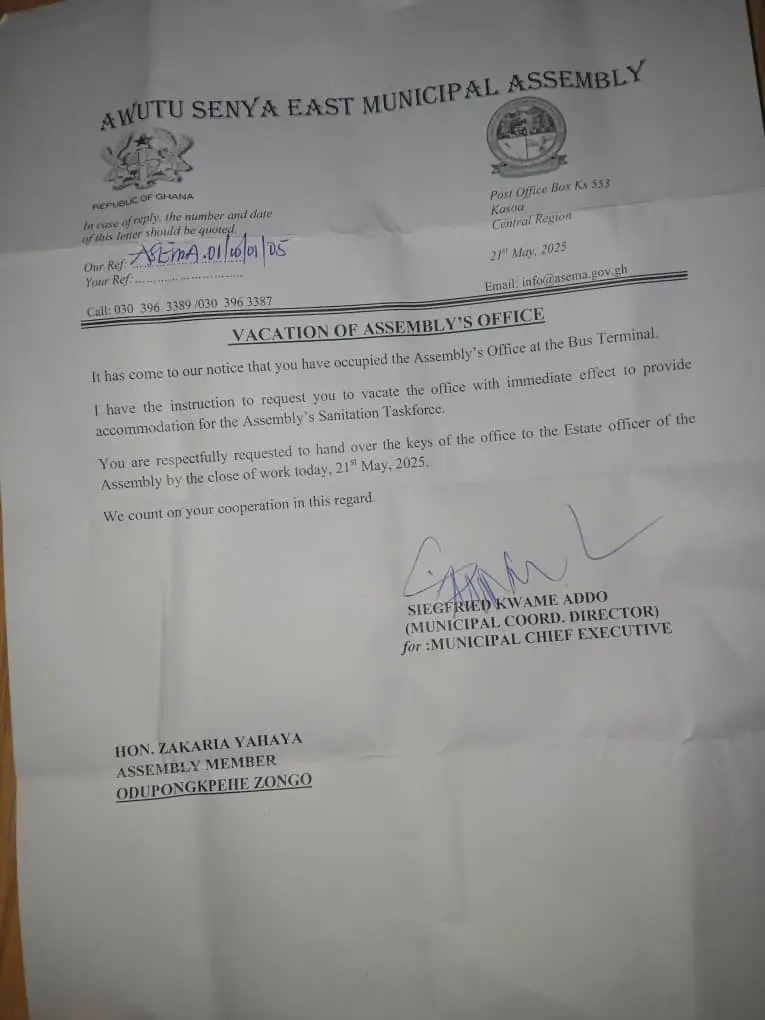
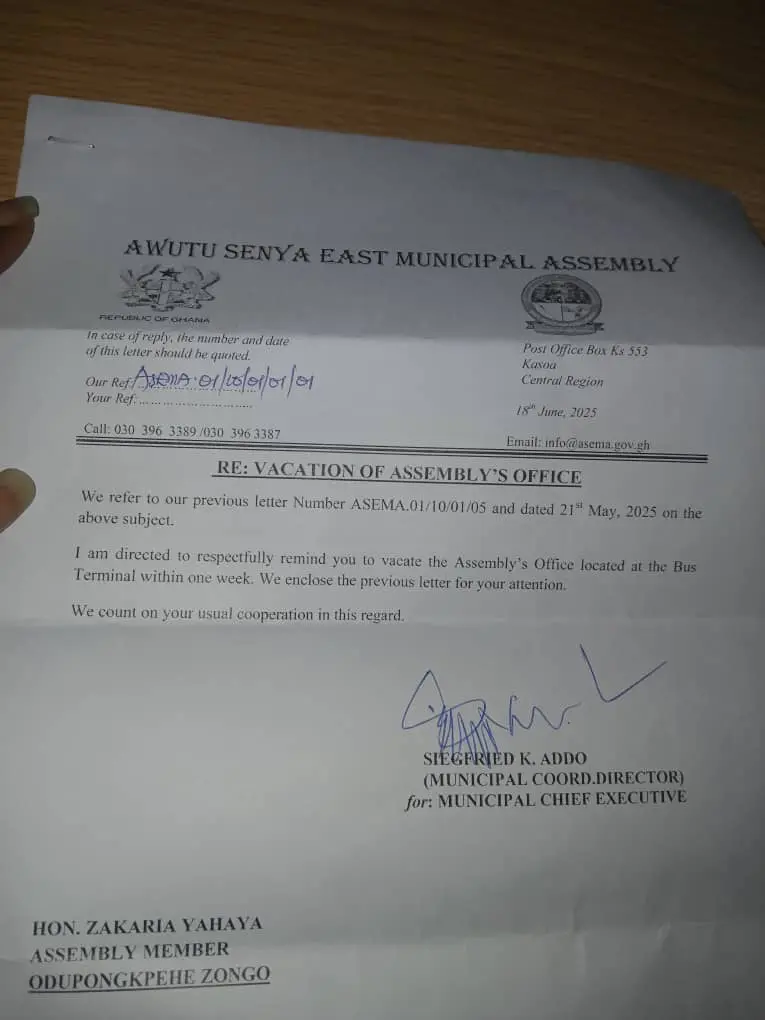
In a further move to stifle the Assembly Member’s authority, a letter signed by the Municipal Coordinator has been issued — the second of its kind — demanding that Zakaria Yahya vacates his office within the bus station. The targeted nature of this eviction suggests deliberate intimidation rather than administrative necessity.
These events raise serious questions: Why is the MCE targeting the Zongo Electoral Area? What is the political or personal motivation behind the relentless interference? And more importantly, what precedent does this set for other Assembly Members who dare to act independently and assertively?
Local governance thrives on collaboration, accountability, and mutual respect. The actions of the MCE and his allies, as outlined above, betray these values. They send a chilling message to community leaders and citizens alike — that power can be used not to build, but to silence and destroy.
The Regional Minister and the Local Government Service must take swift action to investigate these developments. The integrity of Ghana’s decentralization system is at stake. Zakaria Yahya, like all elected Assembly Members, must be allowed to serve his community without fear of political sabotage or executive intimidation.
If the current trajectory continues unchecked, it will not only paralyze development efforts in the Zongo Electoral Area but also embolden a dangerous culture of impunity across the Awutu Senya East Municipality. Democracy, at its core, must begin at the local level — and it must be protected there.