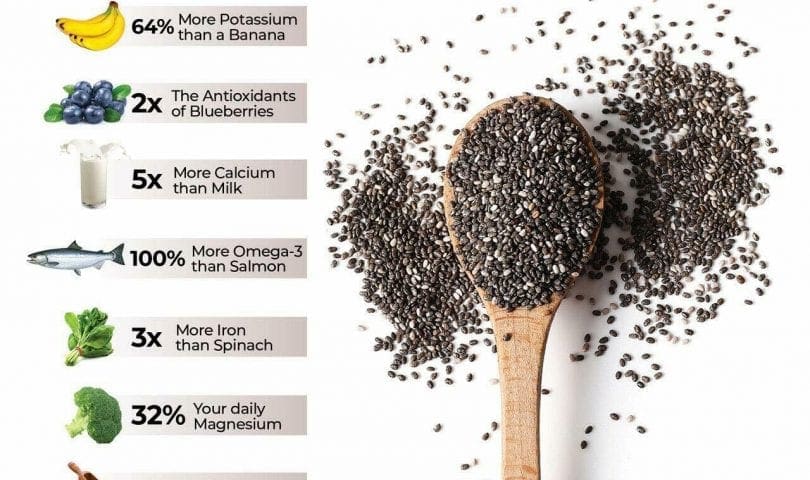

Chia seeds are among the healthiest foods on the planet.
They’re loaded with nutrients that can have important benefits for your body and brain.
Here are 7 health benefits of chia seeds, supported by science.
1. Chia Seeds Deliver a Massive Amount of Nutrients With Very Few Calories
Chia seeds are tiny black seeds from the plant Salvia hispanica, which is related to the mint.
Chia seeds were an important food for the Aztecs and Mayans back in the day.
They prized them for their ability to provide sustainable energy. In fact, “chia” is the ancient Mayan word for “strength.”
Despite their ancient history as a dietary staple, chia seeds became recognized as a modern-day superfood only recently.
In the past few years, they have exploded in popularity and are now consumed by health conscious people all over the world.
Don’t be fooled by the size — these tiny seeds pack a powerful nutritional punch.
A one-ounce (28 grams) serving of chia seeds contains:
- Fiber: 11 grams.
- Protein: 4 grams.
- Fat: 9 grams (5 of which are omega-3s).
- Calcium: 18% of the RDI.
- Manganese: 30% of the RDI.
- Magnesium: 30% of the RDI.
- Phosphorus: 27% of the RDI.
- They also contain a decent amount of zinc,
vitamin B3 (niacin), potassium, vitamin B1 (thiamine) and vitamin B2.
This is particularly impressive considering that this is just a single ounce, equalling 28 grams or about two tablespoons. This small amount supplies only 137 calories and one gram of digestible carbohydrate.
Interestingly, if you subtract the fiber — most of which doesn’t end up as usable calories for your body — chia seeds only contain 101 calories per ounce (28 grams).
This makes them one of the world’s best sources of several important nutrients, calorie for calorie.
To top things off, chia seeds are a whole-grain food, usually grown organically. Plus, they’re non-GMO and naturally free of gluten.
2. Chia Seeds Are Loaded With Antioxidants
Another area in which chia seeds shine is their high antioxidant content.
These antioxidants protect the sensitive fats in the seeds from going rancid (4).
Though the benefits of antioxidant supplements are debated, researchers agree that getting antioxidants from foods can have positive health effects
Most importantly, antioxidants fight the production of free radicals, which can damage cell molecules and contribute to aging and diseases like cancer.
3. Almost All the Carbs in Them Are Fiber
One ounce (28 grams) of chia seeds has 12 grams of carbs. However, 11 of those grams are fiber, which your body doesn’t digest.
Fiber neither raises blood sugar nor requires insulin to be disposed of. Though it belongs to the carbohydrate family, its health effects are drastically different from those of digestible carbs like starch and sugar.
The digestible carb content is only one gram per ounce (28 grams), which is very low. This makes chia a low-carb friendly food.
Because of its high soluble fiber content, chia seeds can absorb up to 10–12 times their weight in water, becoming gel-like and expanding in your stomach.
Theoretically, this should increase fullness, slow absorption of your food and help you automatically eat fewer calories.
Fiber also feeds the friendly bacteria in your intestine, which is important — keeping your gut flora well fed is absolutely crucial for health.
Chia seeds are 40% fiber by weight, making them one of the best sources of fiber in the world.